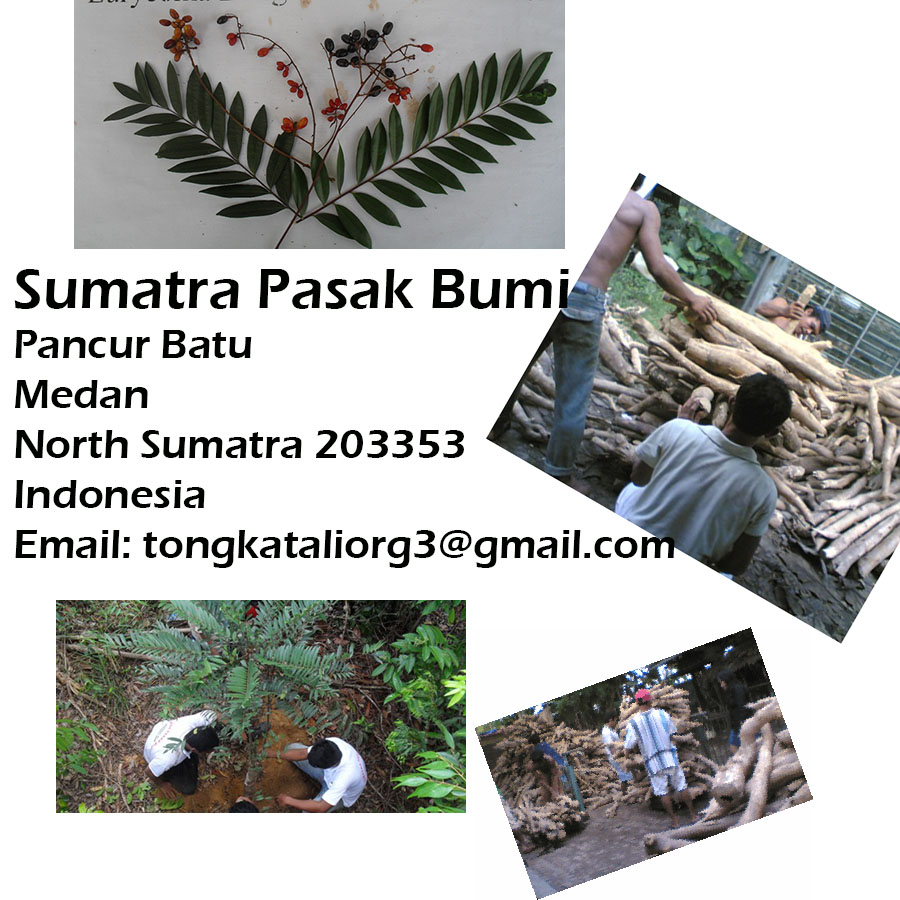
Articles, videos about Tongkat Ali
Tongkat Ali (Eurycoma longifolia Jack): A review on its ethnobotany and pharmacological importance
Rajeev Bhat
, A.A. Karim
https://doi.org/10.1016/j.fitote.2010.04.006
Abstract
Eurycoma longifolia Jack is an herbal medicinal plant of South-East Asian origin, popularly recognized as ‘Tongkat Ali.’ The plant parts have been traditionally used for its antimalarial, aphrodisiac, anti-diabetic, antimicrobial and anti-pyretic activities, which have also been proved scientifically. The plant parts are rich in various bioactive compounds (like eurycomaoside, eurycolactone, eurycomalactone, eurycomanone, and pasakbumin-B) among which the alkaloids and quassinoids form a major portion. Even though toxicity and safety evaluation studies have been pursued, still a major gap exists in providing scientific base for commercial utilization and clearance of the Tongkat Ali products with regard to consumer's safety. The present review aims at reviewing the research works undertaken till date, on this plant in order to provide sufficient baseline information for future works and for commercial exploitation.
Graphical abstract
Eurycoma longifolia in a natural habitat.
Introduction
Traditionally employed, indigenous plant based herbal medicines have been popular from time immemorial, and recently have commanded major attention worldwide due to their potential nutraceutical values [1], [2], [3], [4].
Eurycoma longifolia Jack (Tongkat Ali, Genus: Eurycoma; Family, Simaroubaceae) is one of the most popular tropical herbal plants, indigenous to South-East Asian countries like Malaysia, Indonesia, and Vietnam. Some of the plant species are also found in certain patches in regions of Cambodia, Myanmar and in Thailand. This plant is locally known as ‘Tongkat Ali’ wherein ‘Ali’ means “walking stick” — assigned due to the presence of long twisted roots. The plant extract, especially roots, are exclusively used (traditionally) for enhancing testosterone levels in men. The plant extract (particularly roots) have been used in indigenous traditional medicines for its unique antimalarial, anti-pyretic, antiulcer, cytotoxic and aphrodisiac properties [5], [6], [7], [8]. Root extracts have also been used traditionally to reduce blood pressure, fevers (mainly due to the presence of quassinoids) and fatigue. As regular intake of root extracts is believed to enhance the testosterone levels, increased interest has also been created among the individuals involved in body building to enhance the muscle mass and strength. However, most of the times, the plant extracts forms an essential component in herbal remedies for a wide range of illnesses and as health supplements. Though the exact statistic demand in the international market is obscure, the dried Tongkat Ali roots are known to fetch somewhere between 20 and 25 US dollars/kg. However, the water extracts has been reported to have a better market value of 26 US dollars per bottle of 60 capsules [9].
Of late, there has been a tremendous increase in demand for this plant and nearly 200 Tongkat Ali products, mainly highlighting the aphrodisiac properties, are available in the health-food market [8]. Tongkat Ali products are available either in the form of raw crude powder (of root), as capsule mixed with other aphrodisiac herbs, as an additive mixed with coffee (and ginseng) or in certain health products as a replacement for ginseng.
To our knowledge, till date, no meticulous review is available on Tongkat Ali plant or on its products. Hence, the present review is intended to highlight some of the significant published scientific reports along with providing details of the traditional knowledge of this wonder-plant (mainly E. longifolia Jack). It is envisaged that the baseline information provided in this review will be useful and applicable for future research works aiming towards exploiting the plants nutraceutical potentials.
Section snippets
Taxonomy, cultivation and ethnobotanical uses
Scientific names: there are four different species of Tongkat Ali plant reported till now, which includes: E. longifolia, Entomophthora apiculata, Polyathia bullata and Goniothalamus sp. [10], [11], [12]. However, E. longifolia is used more routinely for traditional medicine purposes.
Popular names: some of the common and popular names of this plant includes: Long Jack, Malaysian Ginseng, Local Ginseng, Natural Viagra, Pasak Bumi, Payung Ali, Penawar Pahit, Setunjang Bumi, Bedara Pahit, Tongkat
Chemical composition
A wide range of chemical compounds have been isolated and characterized from E. longifolia, particularly from the roots. Some of them include: canthin-6-one alkaloids,-ß-carboline alkaloids, quassinoids, quassinoid diterpenoids, Eurycomaoside, tirucallane-type triterpenes, squalene derivatives, biphenylneolignans, eurycolactone, laurycolactone, and eurycomalactone [17], [18], [19], [20], [21], [22]. Fig. 2 depicts the structure of some of the quassinoids isolated form E. longifolia with/
Pharmacological properties
Even though several traditional uses of Tongkat Ali are recognized, a scientific validity and supporting evidence is a pre-requisite for commercial exploitation. In the preceding text some of the available reports pertaining towards the pharmacological potential of the plant extracts are being discussed. Table 2, Table 3 provide an overview of some important works on the pharmacological properties, the isolated chemical compounds and their activity undertaken on the Tongkat Ali plant.
Quality and safety (toxicology, contaminants and side effects)
The major drawback of employing traditional medicines is the lack of adequate supporting scientific information on the levels of safety, quality and toxicity associated. To our knowledge, at present, there are no available reports on the purity (in terms of quality and safety) and on the side effects of long term use of the products prepared from the Tongkat Ali plant. Also, the plant extracts used for commercial preparations might not meet the standard criteria regarding the concentration of
Conclusions
It is evident from the available literatures that E. longifolia Jack, possesses adequate therapeutic potential and could be explored further for commercial purposes, and nevertheless could be designated as a “wonder drug plant.” However, certain features like overcoming international barriers for quality and safety needs to be addressed appropriately. Also, as most of the scientific reports are based on animal experiments, human trials might throw more insight onto the long term safety concerns
References:
Bhat, Rajeev; Sridhar, Kandikere R. (2008) Nutritional quality evaluation of electron beam-irradiated lotus (Nelumbo nucifera) seeds, Food Chemistry
Volume 107, Issue 1, 1 March 2008, Pages 174-184, https://doi.org/10.1016/j.foodchem.2007.08.002
Darise, Muchsin; Kohda, Hiroshi; Mizutani, Kenji; Tanaka, Osamu (1982) Eurycomanone and eurycomanol, quassinoids from the roots of Eurycoma longifolia, Phytochemistry, Vol 1, Issue 8, 1982, Pages 2091-2093, https://doi.org/10.1016/0031-9422(82)83050-1
Darise, Muchsin; Kohda, Hiroshi; Mizutani, Kenji; Tanaka, Osamu (1983) Revision of configuration of the 12-hydroxyl group of eurycomanone and eurycomanol, quassinoids from eurycoma longifolia, Phytochemistry
Volume 22, Issue 6, 1983, Page 1514, https://doi.org/10.1016/S0031-9422(00)84053-4
Morita, Hiroshi; Kishi, Etsuko; Takeya, Koichi; Itokawa, Hideji; Iitaka, Yoichi (1993) Highly oxygenated quassinoids from Eurycoma longifolia, Phytochemistry, Volume 33, Issue 3, Bioorganic & Medicinal Chemistry18 June 1993, Pages 691-696, https://doi.org/10.1016/0031-9422(93)85475-7
Morita, Hiroshi; Kishi, Etsuko; Takeya, Koichi; Itokawa, Hideji; Iitaka, Yoichi (1993) Squalene derivatives from Eurycoma longifolia., Phytochemistry, Volume 34, Issue 3, 18 June 1993, , 765-771 ref. 21, https://doi.org/10.1016/0031-9422(93)85356-V
Miyake, Katsunori; Tezuka, Yasuhiro; Awale, Suresh; Li, Feng; Kadota. Shigetoshi (2009) Quassinoids from Eurycoma longifoliaJournal of Natural Products. 2009, 72, 12, 2135–2140, https://doi.org/10.1021/np900486f
Kuo, Ping-Chung; Damu, Amooru G; Lee, Kuo-Hsiung; Wu, Tian-Shung (2004)Cytotoxic and antimalarial constituents from the roots of Eurycoma longifolia Bioorganic & Medicinal Chemistry, Volume 12, Issue 3, 1 February 2004, Pages 537-544, https://doi.org/10.1016/j.bmc.2003.11.017
Chan, K. L.; Lee, S. P.; Sam, T. W.; Han, B. H. (1990) A quassinoid glycoside from the roots of Eurycoma longifolia. Phytochemistry, 1989, Vol. 28, No. 10, 2857-2859 ref. 5, https://doi.org/10.1016/S0031-9422(00)98108-1
Tada, H; Yasuda, F; Otani, K; Doteuchi, M; Ishihara, Y; Shiro, M (1991) New antiulcer quassinoids from Eurycoma longifoliaNouveaux quassinoïdes antiulcéreux à partir d'Eurycoma longifolia. European Journal of Medicinal Chemistry. Volume 26, Issue 3, April 1991, Pages 345-349. https://doi.org/10.1016/0223-5234(91)90069-Y
Morita, Hiroshi; Kishi, Etsuko; Takeya, Koichi; Itokawa, Hideji; Iitaka, Yoichi (1992) Biphenylneolignans from wood of Eurycoma longifolia, Phytochemistry, Volume 31, Issue 11,Pages 3993-3995, https://doi.org/10.1016/S0031-9422(00)97570-8
Mitsunaga, Katsuyoshi; Koike, Kazuo; Tanaka, Tomoko; Ohkawa, Youko; Kobayashi, Yuko; Sawaguchi, Takako; Ohmoto, Taichi (1994) Canthin-6-one alkaloids from Eurycoma longifolia. Phytochemistry, Volume 35, Issue 3, Pages 799-802, https://doi.org/10.1016/S0031-9422(00)90609-5
Jiwajinda, Suratwadee; Santisopasri, Vilai; Murakami, Akira; Hirai, Nobuhiro; Ohigashi, Hajime (2001) Quassinoids from Eurycoma longifolia as plant growth inhibitors Phytochemistry Volume 58, Issue 6, November 2001, Pages 959-962. https://doi.org/10.1016/S0031-9422(01)00333-8
Shafiqul Islam, A.K.M.; Ismail, Z.; Saad, B. ; Othman, A.R.; Ahmad, M.N.; Shakaff, A.Y.Md. (2006) Correlation studies between electronic nose response and headspace volatiles of Eurycoma longifolia extractsSensors and Actuators B: Chemical, Volume 120, Issue 1, Pages 245-251, https://doi.org/10.1016/j.snb.2006.02.020
Kremsner, Prof Peter Gottfried; Krishna, Prof Sanjeev (2004) Antimalarial combinationsThe Lancet Volume 364, Issue 9430 Pages 285-294
Ang, Hooi Hoon; Chan, Kit Lam; Mak, Joon Wah (1995) Effect of 7-day daily replacement of culture medium containing Eurycoma longifolia Jack constituents on the Malaysian Plasmodium falciparum isolatesJournal of Ethnopharmacology Volume 49, Issue 3, Pages 171-175, https://doi.org/10.1016/0378-8741(95)01321-0
Hout, Sotheara; Chea, Aun; Bun, Sok-Siya; Elias, Riad; Gasquet, Monique; Timon-David, Pierre; Balansard, Guy; Azas, Nadine (2006) Screening of selected indigenous plants of Cambodia for antiplasmodial activityJournal of Ethnopharmacology, Volume 107, Issue 1, Pages 12-18
Chan, Kit-Lam; Choo, Chee-Yan; Abdullah, Noor Rain; Ismail, Zakiah (2004) Antiplasmodial studies of Eurycoma longifolia Jack using the lactate dehydrogenase assay of Plasmodium falciparumJournal of Ethnopharmacology Volume 92, Issues 2–3, Pages 223-227, https://doi.org/10.1016/j.jep.2004.02.025y